Monday, November 28, 2005

Money for nothing

As if losing access to water for several days, and being confronted with the challenges of having Benzene pollute their homes, people in Heilongjiang province in China (China's northernmost province, bordering Russia and North Korea) also face some of the worst mine-safety conditions in the world.

In case regular readers thought I was being tounge-in-cheek this weekend when I mentiond mine collapse as a problem confronted by average Chinese people, the AP has a good (and short) piece about the most recent of China's mine collapses, like many of them, this was in Heilongjiang.

The piece makes a very precise statement, phrased delicately about two competing forces in China's drive to improve mine safety:

"Efforts to shut down dangerous mines have been complicated by the country's
soaring demands for power to drive its booming economy."

I guess reform is hard when the only two sources of power are A. the Party, and B. relationships. It's probably harder when the profits to be made keep going up, while the costs stay the same. The workers are just poor peasants, after all.

Saturday, November 26, 2005

Walk the line

UPDATE, 5:04 pm: This is a great article from the BBC outlining the Harbin-Jilin battle over river contamination, and calls for a more robust government role in regulating the system

Or maybe the tight-rope.

I start this post with "I've been everywhere" playing on my computer, but I'm not thinking of Johnny Cash. I'm thinking of the good ol' CCP. The iron fist of order standing between 1.3 billion Chinese and Turmoil. At least that's how it might view itself. And the trials and tribulations of some 4 million or so people that have so far been disrupted by the benzene spill floating from Jilin north on the Songhua to Harbin, and from there to Russia. (map)

The problem that is being reported today in the Washington Post is the growing sense of public unhappiness over the way the situation was covered/uncovered and how people were lied to. According to the Post, the CCP has banned all newspapers from reporting anything but what is published by Xinhua (the U.S. equivalent would be if the government required all news sources to use Scott McClellan's press briefings as their only source).
There is conflicting news though. Fr. Brian's blog points us to a piece in Chinadaily.com.cn that is remarkably direct in its criticism of the way the situation was handled.

The fact that there is criticism in websites hosted on Chinese servers is surprizing in itself. What is more surprizing is that there are apologies being made by the Jilin provincial government, the Jilin city government, and the companies that operated the plant that blew up.

It seems that the government in China's Northeast is walking a fine line between allowing enough criticism and truth to be uncovered to allow people to vent their fears and frustrations, and yet not allowing so much that people will be emboldened to do something "rash" like start calling for reforms or calling out party/government leaders by name for their contributions to the disaster or the cover up.

My guess is that the only thing working in the government's favor right now is the fact that a long Manchurian winter is just settling in, and the idea of "taking to the streets" in a Parisian way isn't on anyone's mind right now. My bigger fear is that this will quiet down in a week or two, but people will remember it, and if something else goes wrong during warmer months in the next year or two, it will boil over stronger than if people had blown up now.

Authorities near Chongqing might not be as lucky. There were reports a couple days ago about another chemical plant that exploded in Southwest China. It cold there in the winter too, but not as cold as Jilin or Harbin. Let's hope there isn't any chaos coming from that disaster.

I just keep hoping that one of these days, maybe after the 500th mine collapse of the year, or maybe after the 3rd chemical plant explosion in a month that there will start to be structural changes in the way the Chinese operate the regulatory side of the local governments. Clearly what they're doing now is succeeding only at making officials rich and workers dead. Not really a populist notion there.

Thursday, November 24, 2005

Ice and Erhus

This was supposed to be posted yesterday morning right after I got to work, but something got crossed in my emailing it in. So, 30 hours late, here it is:

In the public interest and community news section of the blog today, Wednesday in DC is great.
Why? I broke a frozen puddle at the bus stop this morning. This means winter has finally arrived, and real people are allowed back outside without fear of heat stroke. It was such a nice morning that a co-worker I met crossing the street on the way in said, "I hate the cold but there's something in the air today. It's electric." It's going to be a good day (and we have been "released" at 3 pm, so it'll be a short day).
Also, walking past the subway this morning the normal saxophonist had been replaced. Apparently by a pre-Holiday special musician. He was playing erhu! I mean, what? In DC? That's WAY out of character. But it did make me feel like I was back in a Jilin Karaoke restaurant, so it just added to the greatness that is first-frozen-day of the year.

Sunday, November 20, 2005

Live from the land of Pitt

This is going to be short because of two things:
1. I'm in Pittsburgh hanging out with friends of mine, and
2. One of them just woke up and I should be a bit more social.

But for starters, I've been in Pittsburgh this weekend, checking out my friends' diggs and seeing what life has brought him and his new wife. To be honest, I was expecting post-apocolyptic run-down steel town: something like a cross between Akira and a Soviet-era housing project.

Instead it's been a fun town with a bunch of disparate views, images, and areas. I'm staying with them in a residential neighborhood a short drive from the U. Pitt/Carnegie-Mellon part of town. There's also a revitalized waterfront area; a warehousey-strip-nightlife area; a mis-named Shady Side that's sort of like Grand Ave. in St. Paull; a commercial (and nothing else) downtown; and the rest of the city I didn't see.

The area that struck me most so far was the converted waterfront. It's where a bunch of steel mills used to be, but has now been converted into a phenomenally generic anytown-USA zone for franchises and chains. I'm not saying it's bad: it's green, new, clean, and well put together, but of the 50 or so shops/cafes/restaurants I saw in the area, about 49 of them were unique to nowhere.

I only bring up the waterfront because it (apparently) was an area so quitesentially Pittsburghian (Yinzer, in the local dialect), and has now become so quintessentially not that it seems to me worth commenting on.

By and large though, in my 35 hours in town so far I find Pittsburgh to be a pretty decent town, and one with the potential to become much more dynamic and vibrant rapidly and dramatically if it can find its niche.

I'll write more later. (sorry, no pics as I forgot my camera)

Thursday, November 17, 2005

China's Rise

I've been trying to muster the mental energy to write a piece about U.S.-China relations in the next decade, but haven't gotten there yet. 
 
Since I know you're all clicking refresh at a mouse-destroying pace to get the news with my spin, here's a direct reprint of a piece that was forwarded to me about China's rise.  I haven't finished it yet (actually been doing work recently) but the author is certainly raising interesting points about world power, regardless of how one views his conclusions.


Print this page

John Mearsheimer: The rise of China will not be peaceful at all

18nov05

THE question at hand is simple and profound: will China rise peacefully? My answer is no.

If China continues its impressive economic growth over the next few decades, the US and China are likely to engage in an intense security competition with considerable potential for war. Most of China's neighbours, to include India, Japan, Singapore, South Korea, Russia and Vietnam, will join with the US to contain China's power.

To predict the future in Asia, one needs a theory that explains how rising powers are likely to act and how other states will react to them.

My theory of international politics says that the mightiest states attempt to establish hegemony in their own region while making sure that no rival great power dominates another region. The ultimate goal of every great power is to maximise its share of world power and eventually dominate the system.

The international system has several defining characteristics. The main actors are states that operate in anarchy which simply means that there is no higher authority above them. All great powers have some offensive military capability, which means that they can hurt each other. Finally, no state can know the future intentions of other states with certainty. The best way to survive in such a system is to be as powerful as possible, relative to potential rivals. The mightier a state is, the less likely it is that another state will attack it.

The great powers do not merely strive to be the strongest great power, although that is a welcome outcome. Their ultimate aim is to be the hegemon, the only great power in the system. But it is almost impossible for any state to achieve global hegemony in the modern world, because it is too hard to project and sustain power around the globe. Even the US is a regional but not a global hegemon. The best that a state can hope for is to dominate its own back yard.

States that gain regional hegemony have a further aim: to prevent other geographical areas from being dominated by other great powers. Regional hegemons, in other words, do not want peer competitors. Instead, they want to keep other regions divided among several great powers so that these states will compete with each other. In 1991, shortly after the Cold War ended, the first Bush administration boldly stated that the US was now the most powerful state in the world and planned to remain so. That same message appeared in the famous National Security Strategy issued by the second Bush administration in September 2002. This document's stance on pre-emptive war generated harsh criticism, but hardly a word of protest greeted the assertion that the US should check rising powers and maintain its commanding position in the global balance of power.

China - whether it remains authoritarian or becomes democratic - is likely to try to dominate Asia the way the US dominates the Western hemisphere.

Specifically, China will seek to maximise the power gap between itself and its neighbours, especially Japan and Russia. China will want to make sure that it is so powerful that no state in Asia has the wherewithal to threaten it. It is unlikely that China will pursue military superiority so that it can go on a rampage and conquer other Asian countries, although that is always possible.

Instead, it is more likely that it will want to dictate the boundaries of acceptable behaviour to neighbouring countries, much the way the US makes it clear to other states in the Americas that it is the boss. Gaining regional hegemony, I might add, is probably the only way that China will get Taiwan back.

An increasingly powerful China is also likely to try to push the US out of Asia, much the way the US pushed the European great powers out of the Western hemisphere. We should expect China to come up with its own version of the Monroe Doctrine, as Japan did in the 1930s.

These policy goals make good strategic sense for China. Beijing should want a militarily weak Japan and Russia as its neighbours, just as the US prefers a militarily weak Canada and Mexico on its borders.

What state in its right mind would want other powerful states located in its region? All Chinese surely remember what happened in the 20th century when Japan was powerful and China was weak. In the anarchic world of international politics, it is better to be Godzilla than Bambi.

Furthermore, why would a powerful China accept US military forces operating in its back yard? American policy-makers, after all, go ballistic when other great powers send military forces into the Western hemisphere. Those foreign forces are invariably seen as a potential threat to American security. The same logic should apply to China.

Why would China feel safe with US forces deployed on its doorstep? Following the logic of the Monroe Doctrine, would not China's security be better served by pushing the American military out of Asia?

Why should we expect the Chinese to act any differently than the US did? Are they more principled than the Americans are? More ethical? Less nationalistic? Less concerned about their survival? They are none of these things, of course, which is why China is likely to imitate the US and attempt to become a regional hegemon.

It is clear from the historical record how American policy-makers will react if China attempts to dominate Asia. The US does not tolerate peer competitors. As it demonstrated in the 20th century, it is determined to remain the world's only regional hegemon. Therefore, the US can be expected to go to great lengths to contain China and ultimately weaken it to the point where it is no longer capable of ruling the roost in Asia. In essence, the US is likely to behave towards China much the way it behaved towards the Soviet Union during the Cold War.

China's neighbours are certain to fear its rise as well, and they too will do whatever they can to prevent it from achieving regional hegemony.

Indeed, there is already substantial evidence that countries such as India, Japan, and Russia, as well as smaller powers such as Singapore, South Korea and Vietnam, are worried about China's ascendancy and are looking for ways to contain it. In the end, they will join an American-led balancing coalition to check China's rise, much the way Britain, France, Germany, Italy, Japan, and even China, joined forces with the US to contain the Soviet Union during the Cold War.

Finally, given Taiwan's strategic importance for controlling the sea lanes in East Asia, it is hard to imagine the US, as well as Japan, allowing China to control that large island. In fact, Taiwan is likely to be an important player in the anti-China balancing coalition, which is sure to infuriate China and fuel the security competition between Beijing and Washington.

The picture I have painted of what is likely to happen if China continues its rise is not a pretty one. I actually find it categorically depressing and wish that I could tell a more optimistic story about the future.

But the fact is that international politics is a nasty and dangerous business and no amount of goodwill can ameliorate the intense security competition that sets in when an aspiring hegemon appears in Eurasia.

That is the tragedy of great power politics.

John Mearsheimer is professor of political science at the University of Chicago and the author of The Tragedy of Great Power Politics (W.W. Norton, 2001).

Sunday, November 13, 2005

Wisdom from unexpected sources

Sunzi said it,

"...[k]now your enemy"
And amazingly enough, none other than George Will is pointing out potential opportunities for Democrats in 2008. He's also pointing out cleavages in the American political system that don't necessarily fall along party lines. He doesn't quite say it, but it's left for inferrance that the cleavages are there for whichever candidates are capable of exploiting them.

He uses Russ Fiengold's classical North-central progressivism as an example of how the label "progressive" is not stictly a D or an R label in the 21st century--much like it was not a D or an R label in the 20th when laid upon Robert LaFollette Sr. at the end of the 19th century. I would go further than Will to say the values espoused by Fiengold: fiscal responsibility, government spending to fill in where markets fail (minimum wage, retirement benefits, etc), a foreign policy that creates a better world, and a government that works to ensure that all Americans have the opportunity they work hard to earn.

Who knows, we might have an election in 2008 that will bring real issues to the fore. At least a guy can hope, right?

Explosion rocks Jilin

In a break from the sarcasm and sardonic posts of late, here is real news.

Jilin City, where I lived in China, pretty much has one primary industry left. Chemical production facilities. It's trying to branch out into other things like manufactoring, semi-conductors, and even fruit juice. But the one big employer in the city is the chemical industry.

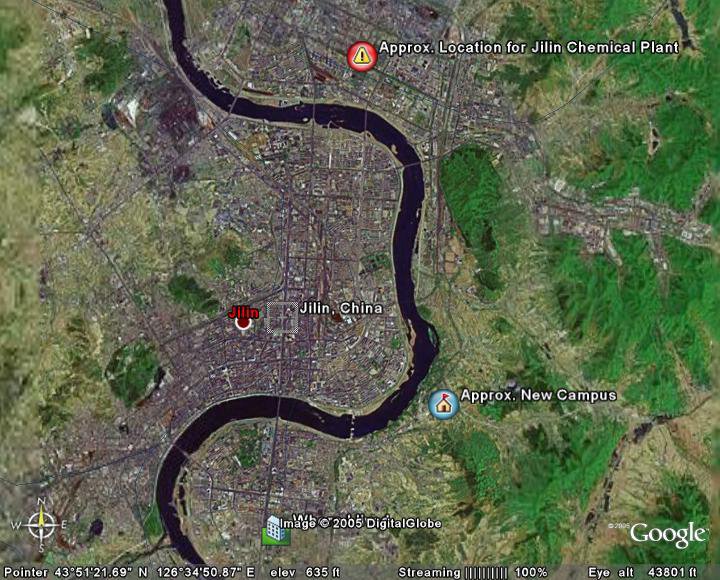
It just got rocked Sunday. Major explosions apparently hit a workshop/facility in the north of the city. So far, no fatalities reported, though there have been reports of 30 injured. 10,000 additional people have been evacuated because of fears of further explosions, or (more significantly) polution and smoke being released from the factory. Apparently the one that suffered the explosion produces benzene.

It happened about 6 or 7 miles north (I'm just guessing, as all distance measurements in China seem to be time-based, not geography based) of where I lived. You can mostly see it in this map...my university was the icon on the south edge of the map, partially obscured by the copyright.

Apparenly, none of the people I know in town were around the facility at the time it exploded, so I'm hopeful it stays that way, but I'm guessing more news will trickle my way in the next few days.

Isolation, exclusion, and consequences

For decades, possibly centuries, the French have been vigilantly guarding the essence of "Frenchness."

One result of this pattern of behavior has been the difficulty immigrants--especially North African immigrants--have had integrating into French society. It's not easy for most immigrants to integrate into a new culture and society.

Even in the U.S., with our history of successive groups of immigrants, each new wave has faced serious challenges to becoming accepted members of their local communities. Look no further than the Hmong, Somali, or Latino arrivals in Minnesota for the challenges they are facing--some even 25 years after they've arrived.

For the French, the challenges with immigration are greater, because of the enormous value placed on the "traditional" in France. Unlike the United States, it's nearly impossible for most people not born to French citizens to become citizens. This means they can't vote or become complete participants in the local civic life. It also means that the issues and interests one has are going to be ignored by the local political leadership.

Now, where can we find examples of people who have been dispossessed by local political leadership? Where they have isseues to be addressed, no recourse to address abuses or shortcomings? There are a few places coming to mind, but none of them are as well known around the world as the Palestinians.

And remarkably, the dispossessed in France are behaving much like the dispossessed in Palestine.

Let's see if the French come up with a better solution to their uprising than we've seen used in Palestine. I'm not confident we will.